Monday, March 12, 2012

john


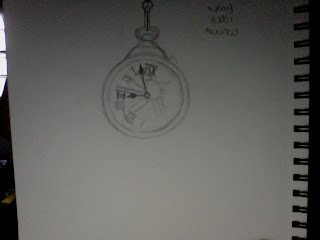
             this is a working progress done in graphite pencil so far still have alot to do on this piece..the subject matter is my idea with native american skeletons with spirituality its going to be a native shaman with a raven in his hands which to a lot of tribes  symbolizes death

Tiffany: Trying to catch up


I've been very behind in my daily drawings so this post is me trying to catch up. 1:
This is a sketch i did for a friend. It's not complete nor is it a final but it's a thought process.
2:
This is another sketch I did for myself as an outline:
Sketch 3:


Artists


Alot of artists I'm interested in go beyond the basic frame of just drawing and painting and delve into the multi media range. I've always been interested in using a wide variety of materials in my work because it brings a certain wonderful eclectic decoritive nature to a piece and gives it a sense of almost being alive. There are three artists who's work I keep bumping into and their pieces fit these interests. The first is Ahmad Nadalia, an Iranian ecoartist who uses carving and printing on earth surfaces.


The second artist is Nancy Martini, an encaustic (wax)artist.


The final artist is Kenojauk Asheva, an inuit artist that uses print and drawing that draws from inuit folk tradition.


Upcoming event


Just a heads up:
Public Discussion & Catalogue Launch
Rhetoric of Protest: Beyond Occupy
Saturday 17 March 2012, from 6:00pm – 8:00pm
at Vox Populi, 319 N. 11th Street, 3rd Floor, Philadelphia, PA 19107
Discussion
On the occasion of the exhibition Five Acts: Chronicles of Dissent, Marginal Utility will be hosting a discussion on the structure, imaging, and personal affect of protest. Please join us on Saturday, March 17th at 6PM for a conversation with two contributors to the exhibition, NAEEM MOHAIEMEN and MARK TRIBE, the exhibition curator YAELLE AMIR, and Slought Foundation’s executive director and chief curator, AARON LEVY.

We will ask: what are successful models of protest? How do we frame an act of dissent? What part does creativity play in its formation? Do recent structures limit its participants or engage them further? To understand the various experiences of dissent, we will look at models of the past, as well as current examples from the Arab Spring and the Occupy Movement.
FIVE ACTS: CHRONICLES OF DISSENT
With massive demonstrations spreading throughout the Arab world, Europe, and the United States, the voice of marginalized people is being heard clearly far and beyond their communities. While in many instances the outcome of these revolutions cannot yet be determined, their aims have been made clear. The various demonstrations have taken on different methods, but what remains consistent is the protesters’ ability to effectively communicate their message—with their demands infiltrating televisions, newspapers, virtual communities, and dinner table discussions around the world. The number of participants, stern language, location, and tactics are all considered elements that play into the ultimate effectiveness of the protesters’ actions. Five Acts: Chronicles of Dissent observes these factors through video, photography and text-based works that record and re-stage global acts of protest.

The participating artists reach back into history to make connections to issues still relevant today, while others document a recent action in order to bring to light an event that has had little exposure. Yael Bartana, Andrea Bowers, and Naeem Mohaiemen have documented unique acts of dissent concerning political, environmental, and religious issues. Sharon Hayes and Mark Tribe re-purpose iconic protest acts that significantly altered historic political issues. The exhibition addresses issues of war, political freedom, environmental disaster, and gay rights through diverse means, thus suggesting the existence of a rich language by which to communicate one’s opinion. Melding rhetoric with action, and history with present concerns, Five Acts examines the ways in which social movements and dissenting individuals convey their mission. 
HOME ON THE WEB
www.marginalutility.org. The website features information on all current and past exhibitions, a calendar of events, Machete activities, etc.

You can also follow us on Twitter: twitter.com/mu_inc
Become a fan on Facebook: www.facebook.com/marginal.utility
CONTACT US
If you have any questions, please contact: exhibition@marginalutility.org
319 N. 11TH STREET, 2ND FLOOR, PHILADELPHIA, PA 19107
PHONE 917.355.4487 WWW.MARGINALUTILITY.ORG
HOURS: SATURDAY-SUNDAY 12:00–5:00 PM


Jordan Post 5

My Michelangelo made contemporary drawing is shown below, the original intentions being to make commentary on a materialistic world and exhibit idealization in a different way. It is soon still a work in progress, I plan to further investigate quality of the figures as suggested and Im thinking to add another material such as gauche. 
I have a not so good camera so I had to increase the contrast so you could see everything


My idea for the next project is to use text from Dante's Inferno in the epic poem Devine Comedy. My plan is to do painterly illustrations representing the 9 levels of inferno (hell). I am still really longing and set to attempt a wall drawing. I think it would have more of an impact and add content for the piece. So its something Im considering. It of course will be well documented. Below is research I began with. Ive been thinking about this for a long time it took me a while to decide what to do. Had a bit of an artist block. More to be posted tomorrow


Saturday, March 10, 2012

Jason Moorer- Post 8: Stewart Mader and Daily Drawing


I found this artist on Gawkerartist.com, a site I love because almost all of the spotlighted artists are contemporary and working today. Stewart Mader is a photographer who captures high-rises and skyscrapers mainly in New York. There seems to be a lot of emphasis on formal qualities, and the architecture is given a whole new appreciation once Mader documents them through photography. Most of the buildings are from the 20th century. This is a quote I like from him;

The “view from the elevator” metaphorically speaking, represents the idea of a broad, expansive view from a perspective high above the din of everyday life.


My drawing this week is a study if you will for the next assignment. While looking through ELLE Décor or VOGUE Living, I’ve found this obsession with designer-brand furniture and accent pieces, with emphasis on the display of the company’s logo. It’s such a “nouveau riche” thing to have like Versace dinnerware and Gucci glasses for drinking- I feel like this is a 21st century thing as well.

Below are Fendi pillows.


Wednesday, March 7, 2012

Ben Post 6

Here's my drawing for our second assignment, "Study for the final".
This is a graffiti piece i did this week for fun. Even though i do this type of drawing for fun i think it incorporates its way into my class drawings. I'm very attracted to the lifestyle of graffiti and the complex process of creating a piece. I try to take my interest of connections, morphing, and trickery in graffiti lettering to my drawings, and into a fine art setting without being too corny.
These are all examples of graffiti artist's complex word play, and fine art work.
artist: Augor
artist: Saber
artist: Askew

http://vimeo.com/askewone/smokesignalsshow This is also a video highlighting artist, "Askew".
I think he's a great example of a street artist who moved into the fine art world, and someone who's
extremely creative and influential.


Monday, March 5, 2012

Sara Post VI


 I forgot to post this drawing to the blog last week. I had taken a picture of a swirly blob of paint I scraped from my palette and began to sketch it in graphite. After a few minutes it started to look like an elderly fish, so I exaggerated it's fish-like features. I had forgotten that art doesn't always have to be so serious and that I can goof off sometimes if I want to until I started my internship with a local Philadelphia artist this semester.


Marie Ulmer, 95, graduated from the University of the Arts (Museum School)  illustration department in 1941. I'm in charge of inventorying at least 100 pieces of her life's work and it's been amazing to see all the things this little woman has made. She has hundreds of watercolor still life's, portraits, cityscapes, and landscapes and has worked with silkscreen, acrylics, ceramics, fibers, found objects... pretty much everything. Sometimes she can work very realistically and other times she lets her illustrative side out. Her favorite works are what she calls her "fantasy" pieces which are done in a variety of media. I've asked her about her favorite mediums and subject matter and she says she just loves to make things, she's not picky about the what or the how.


Annnd here's my "Study for the Final" conte drawing.